We don't stop at releasing.
We rebuild movement.
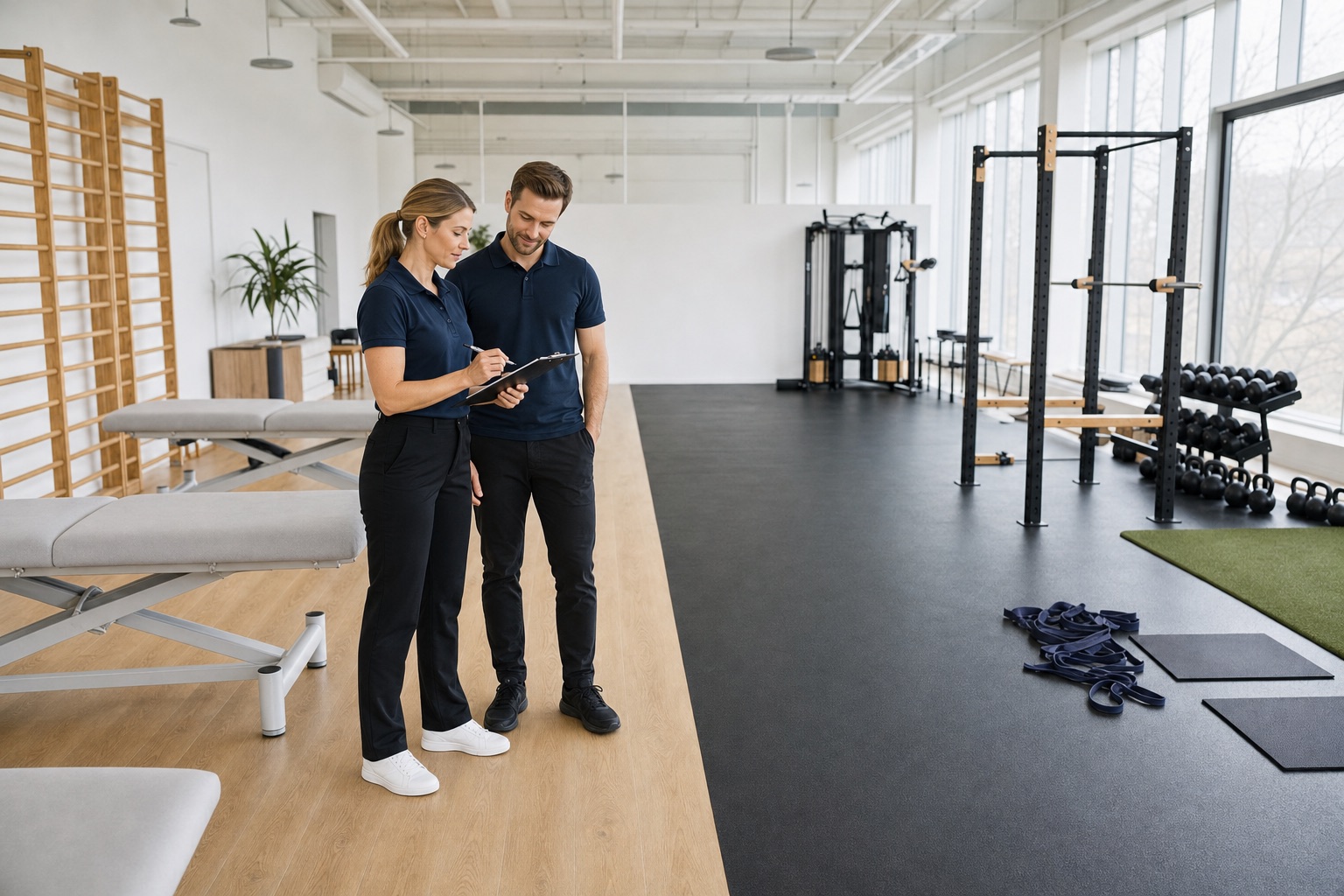
Not a place that just releases you. A place that rebuilds movement.
For a long time we were taught to release what is tight, stretch what is stiff, and strengthen what is weak. But the same discomfort returns not only because a muscle is weak. Moving the same way for a long time tends to narrow the range you use.
BODYCHECK is where we measure that range, practise using it again, and re-measure. We run a method built with reference to textbooks and journal papers in motor control and motor learning, to one standard and one flow. We build a body that can move on its own, not one that waits for someone else's hands.
P-Stretching (Passive Stretching) is assisted stretching organised from international exercise research and hands-on experience.
It looks like relaxation care, but it isn't. It looks like a gym, but it isn't. Releasing is the entrance; learning is the exit. We provide 1:1 conditioning in which the same person takes responsibility for the entire flow.
Too Flexible is Unstable.
Too Stable is Stiff.
With only flexibility or only stability, the body tires easily. We design the balance between them, one to one.
Movement first, muscles second.
How a muscle is used changes movement more than how big it is.
Releasing is the start, not the end.
Passive care is the entrance. Active learning is the exit.
The body remembers what it uses.
Movement is learned through the precision of practice, not the number of repetitions.
It settles in daily life.
Changes inside the center hold only when they extend into daily life.
We do / We don't
| We do | We don't |
|---|---|
| Run analysis → plan → learning, in order | Push everyone through a one-size-fits-all program |
| Combine passive + active care | Only release / only exercise |
| A method designed on the papers and textbooks of international researchers | Decide by 'feeling' or 'gut' |
| 1:1 dedicated care | Several people handled at once |
| Design through to daily-life movement | Only lasts inside the studio |
Movement specialists,
finding how you move again.
The same person stays with you from analysis to exercise.
The research
behind this system
Papers and textbooks by international researchers in motor control, motor learning and movement assessment, with where each one shows up in our method.
Musculoskeletal & movement system
- Shirley SahrmannWashington University in St. Louis
Diagnosis and Treatment of Movement Impairment Syndromes. Mosby, 2002.
The movement-system frame behind our analysis
- Stuart McGillUniversity of Waterloo
Low Back Disorders: Evidence-Based Prevention and Rehabilitation. Human Kinetics.
Order and load of trunk-stability exercise
- Jeremy LewisUniversity of Hertfordshire · University of Limerick
Inter-rater reliability of the Shoulder Symptom Modification Procedure in people with shoulder pain. BMJ Open Sport & Exercise Medicine, 2016.
Shoulder assessment by modifying movement
- Jan WilkeGoethe University Frankfurt
What is evidence-based about myofascial chains: A systematic review. Archives of Physical Medicine and Rehabilitation, 2016.
How far P-Stretching works along fascial chains
- Gray CookFunctional Movement Systems, USA
Pre-participation screening: the use of fundamental movements as an assessment of function (Part 1·2). North American Journal of Sports Physical Therapy, 2006.
Screening the fundamental movement patterns
Fear of movement
- G. Lorimer MoseleyUniversity of South Australia
Explain Pain (with David Butler). Noigroup Publications.
Explaining movements step by step to people afraid to move
- David ButlerNeuro Orthopaedic Institute, Australia
Explain Pain (with G. Lorimer Moseley). Noigroup Publications.
How we talk with people afraid to move
Motor control & learning
- Anne Shumway-CookUniversity of Washington
Motor Control: Translating Research into Clinical Practice (with M. H. Woollacott). Wolters Kluwer.
Designing stages to relearn balance and posture
- Marjorie H. WoollacottUniversity of Oregon
Motor Control: Translating Research into Clinical Practice (with A. Shumway-Cook). Wolters Kluwer.
How balance control changes with age
- Richard A. SchmidtUCLA
Motor Control and Learning: A Behavioral Emphasis (with T. D. Lee). Human Kinetics.
Learning movement through practice and feedback
- Timothy D. LeeMcMaster University
Motor Control and Learning: A Behavioral Emphasis (with R. A. Schmidt). Human Kinetics.
Practice order and feedback frequency
- Pavel KolářCharles University · Motol University Hospital
Dynamic Neuromuscular Stabilization & Sports Rehabilitation. International Journal of Sports Physical Therapy, 2013.
Breathing and core pressure in neuro-muscular activation
- Alena KobesováCharles University · Motol University Hospital
Developmental kinesiology: Three levels of motor control in the assessment and treatment of the motor system. Journal of Bodywork and Movement Therapies, 2014.
Developmental patterns applied to adult learning
The researchers below have no direct relationship with BODYCHECK Care; we drew on their published work.
We will figure out
where to start, together.
Your first visit starts with a 50-minute first assessment (₩50,000). Not sure what you need? Get a free consultation on KakaoTalk first.